How to Run a Re-Engagement Email Campaign: Step-by-Step

Do you send email newsletters regularly but rarely check the analytics? Over time, even a healthy email list can lose some of its momentum. A re-engagement campaign can help you reconnect with subscribers.
At the Purpose Collective, we have worked with dozens of nonprofits that spent years building strong email lists to share updates and appeals. For these organizations, we have written email campaigns that have collectively generated six figures in gifts from supporters! When email is such a valuable communication channel, strong deliverability is essential, and a re-engagement campaign can help improve it.
Why you need a re-engagement email campaign
Any organization that has an email list could benefit from a re-engagement campaign. Over time, every organization accumulates disengaged subscribers on its email list. Some of these are “ghosts”—people who subscribed but have never opened an email or clicked on a link. Others are “zombies”—people who used to engage but haven’t done so in a while.
Marketing Sherpa reports that an average email list decays by 25% each year. If you can relate to this, you’re not alone! Fortunately, there are steps you can take to improve the quality of your email list.

What is a re-engagement email campaign?
A re-engagement email campaign is a tool to reconnect with subscribers who have become less engaged over time. It also cleans up your email list in the process. Think of it like reaching out to old friends. Some will respond, some won’t, and a few may rekindle a meaningful connection. This process improves data hygiene and email deliverability for future newsletters.
Benefits of running a re-engagement email campaign
We work with nonprofits to create re-engagement email campaigns and the benefits are nearly always worth the investment. Here are several benefits we have seen firsthand:
Stronger relationships: If a supporter has started to drift away, this is your chance to reel them back in. You can renew their enthusiasm for your mission.
Improved email deliverability: Major email providers (like Gmail and Outlook) use engagement rates to determine whether emails land in inboxes or spam folders. Too many disengaged subscribers can negatively impact your deliverability. When this happens, it means that even engaged supporters might not see your messages. Cleaning up your email list will boost your deliverability!
Reduced costs: Many email marketing platforms (like Mailchimp) charge based on list size. Keeping inactive subscribers means you may be paying more than necessary.

How to run a re-engagement campaign: Step by step
When clients ask about the health of their email list, we review subscriber engagement. We often find many people who have received emails for years but rarely open them. In some cases, that number can reach the thousands! From there, we create a re-engagement plan using the steps below.
Step 1: Identify your audience
If this is your first time running a re-engagement email campaign, start small. You can always iterate and expand. A good starting point is targeting 5% of your audience—focusing on those who are the least engaged.
To segment your list, identify subscribers who:
Haven’t opened any of your last 5 emails
Haven’t clicked a link in your last 10 emails
Haven’t engaged with your emails in the past 6 months
Have a low engagement rating (depending on your email provider)
Different email platforms offer various segmentation tools. For example, Mailchimp allows filtering by contact rating, email engagement, and interaction history. Use these features to build the right audience list for your campaign.
Your mission deserves to be shared, not squeezed in.
When your team is stretched thin, content creation is often the first thing to slip. We can carry that load for you, crafting thoughtful, mission-aligned content across social media, email, reports, donor communications, and year-end campaigns.
Step 2: Draft your re-engagement emails
Re-engagement campaigns typically consist of a few emails. This gives your subscribers several chances to reconnect with you and engage with the type of content that resonates with them. Three emails is a solid starting point for most campaigns.
Re-engagement email examples
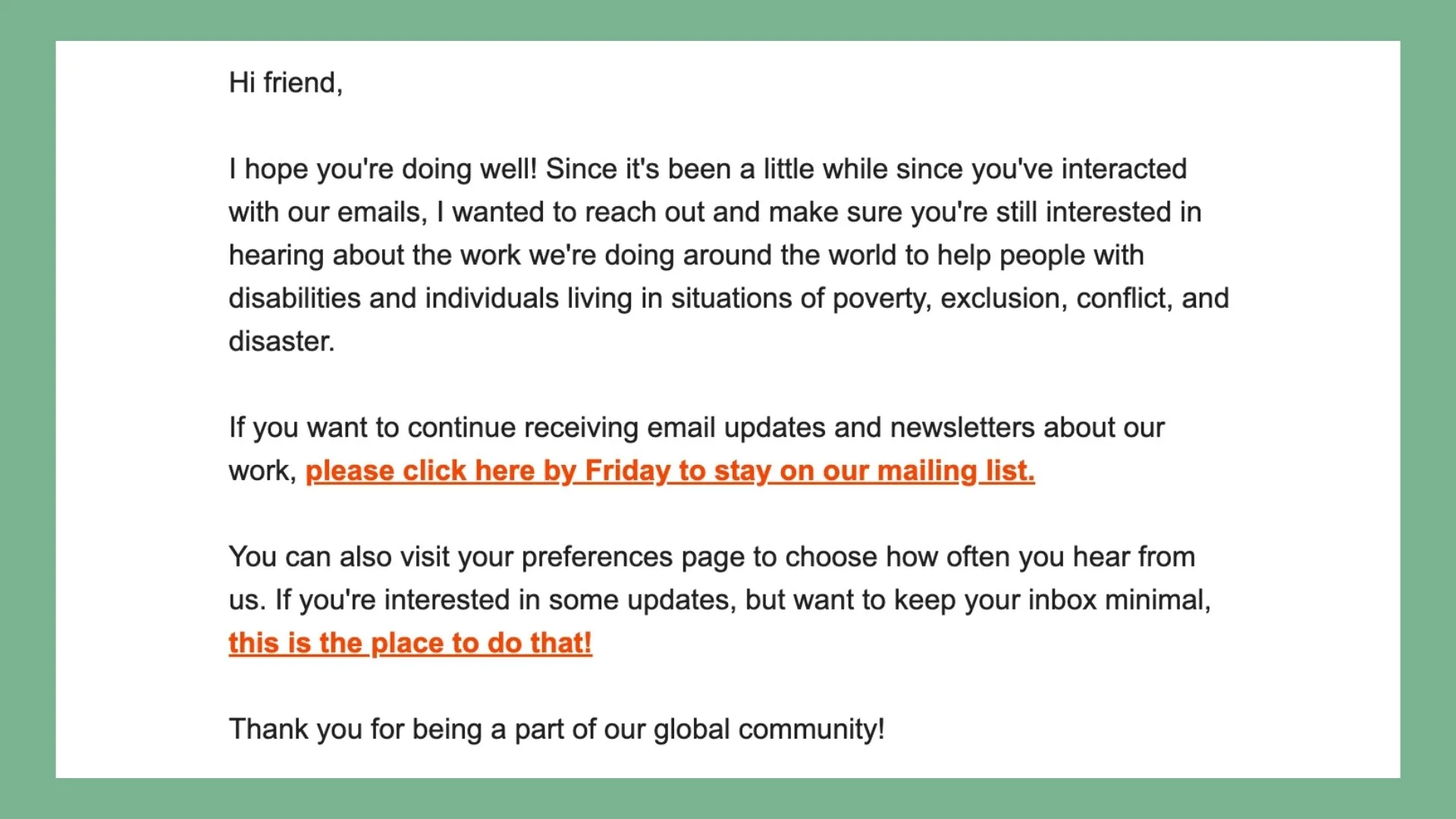
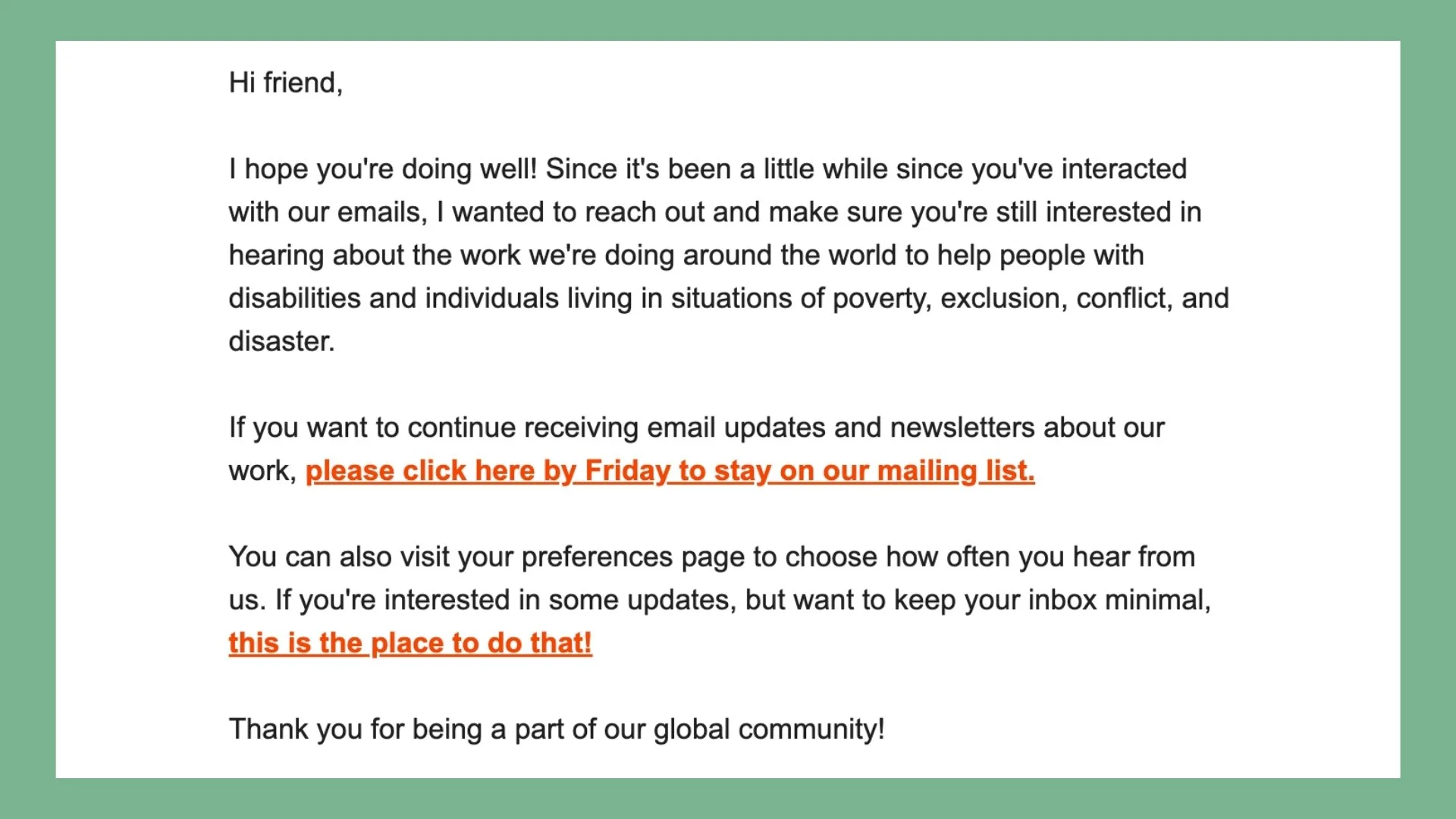
There are many ways to approach a re-engagement email. Try something new to capture your audience’s attention, while still including some of the content you regularly share. The goal is to reconnect subscribers with the emails they can expect to receive moving forward.
Send a simple plain text email:
Create an opportunity to stay on the list:
Source: Humanity & Inclusion U.S.
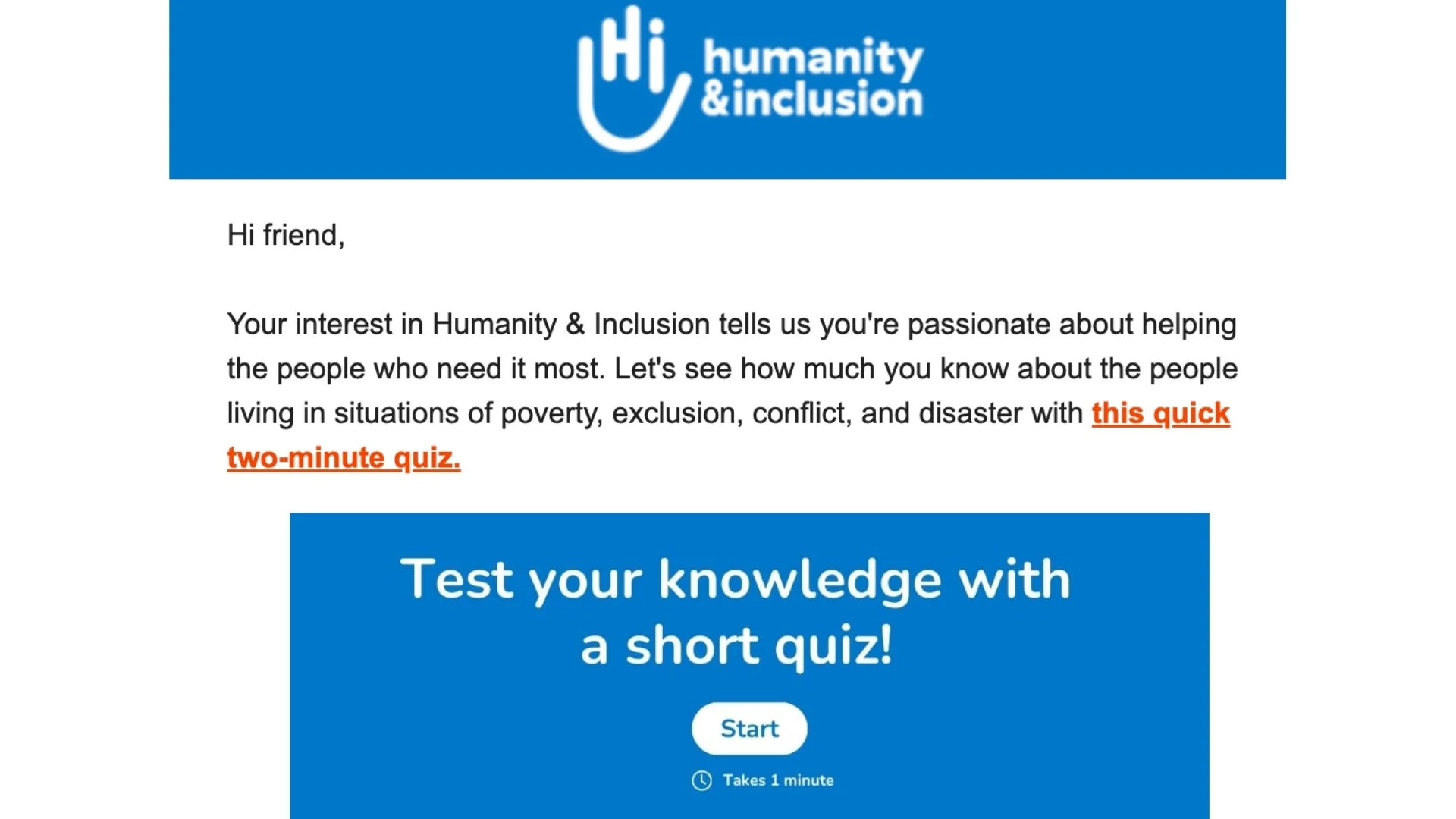
Include a fun quiz like these examples:

Source: Humanity & Inclusion U.S.
Tips for crafting effective re-engagement emails:
Use attention-grabbing subject lines. Try playful and personal subject lines like:
“You still there?”
“Is it something we said?”
“We miss you!”
“Is this thing on?”
“Do you still want to hear from us?”
Experiment with email length. Test both short-and-sweet messages and longer storytelling approaches.
Add interactive elements. Incorporate a fun survey, quick quiz, or personalized call-to-action to boost engagement.
Space your emails out three days to a week apart to give your supporters multiple opportunities to reconnect.

Step 3: Run the campaign
Before launching your campaign, there are a few final logistics to work out. You want to decide what qualifies as “engaged” behavior. This will bump someone out of your re-engagement campaign and keep them on your email list.
A subscriber may be considered engaged if they:
Open any of your re-engagement emails
Click any link in your emails
Click a “Yes, keep me subscribed” button
Once you’ve defined engaged behavior and finalized your emails, use your email provider’s automation or workflow tools to schedule the campaign. Because these emails target inactive subscribers, you can expect lower engagement rates than you typically see.
Step 4: Archive your unengaged audience
According to Convertcart, the average open rate for a re-engagement campaign is around 10%. In our experience, even a 5% re-engagement rate is a solid result. Once the automation is built, you can continue using it to re-engage future subscribers.
Afterward, archive contacts who don’t re-engage. This allows you to keep a record of them without counting them toward your active subscriber list. Ultimately, you're reducing costs while maintaining a cleaner, healthier email database.
Keep your list healthy with regular email segmentation
A re-engagement campaign is a powerful reset, but you don't have to wait until subscribers go quiet to protect your email deliverability. One of the best habits you can build is segmenting your email campaigns by engagement level on a regular basis.
For our nonprofit clients, we use a simple red, yellow, green approach with our clients, and we recommend it for any organization that wants to keep its email performance strong. The idea is to match how often you email someone to how interested they actually are:
🟢 Green (most engaged): These subscribers regularly open, click, and interact with your emails. Send them all your email campaigns—they want to hear from you.
🟡 Yellow (less engaged): These folks interact sometimes, but not consistently. Send them fewer emails to warm them up without overwhelming them.
🔴 Red (least engaged): These subscribers rarely open or click. Send them only your most important or likely-to-perform-well emails.
Why does this matter? When you email disengaged subscribers too often, your engagement rates drop, and that quietly hurts your deliverability for your whole list.
Segmenting by engagement helps you send more relevant content, protect your sender reputation, and match your email frequency to your readers' real interest. It's one of the easiest ways to keep your nonprofit email marketing healthy all year long.
Ready to win back subscribers who have disengaged?
Our Re-engagement Campaign Guide makes it easy to reconnect with subscribers who have gone quiet. It walks you through segmenting your list and improving your email deliverability, and drafting a simple three-part email series complete with writing prompts and send dates. Everything you need to reignite interest in your work, all in one place.