
Use This Word in Your Nonprofit Donor Communications to Raise More Money

What if one word in your nonprofit communications could make your donors feel more valued and more likely to give again?
It can, and that word is “you.”
But here’s the problem (and the opportunity for you): most nonprofits don’t know this. They aren’t using “you” often enough in their communications. Instead, their emails, appeals, and social media posts are packed with a different word.
“We launched.” “We raised.” “We achieved…”
When a supporter opens your email and sees “we did this, we did that, we, we, we,” something happens in their brain. They stop feeling connected. They start feeling like they’re reading a press release. Or worse, like they’re sitting through a brag session. And they click away.
In this article, you'll discover why one tiny word can transform your donor communications, build deeper connections, and inspire more giving. Plus, find out you can put these learnings into practice today.
Beware of the “we” trap in donor communications
One of the most common challenges we see in nonprofit communications—especially in communications with donors—is writing about “we.”
We get it. You are the one working incredibly hard to make progress towards your mission. You’re proud of what your organization has accomplished. You should be!
So when it’s time to write an email, social media post, or appeal letter, it feels natural to report to your donors and followers on all the latest updates. The programs you ran, the people you served, the goals you hit. The natural instinct is often to write it as, “We served 500 families this year,” “We couldn't have done it without your support,” and “We are thrilled to announce our new program.”
If this sounds like you, don’t panic. The vast majority of nonprofits communicate this way. But your donors don’t want to read about you. They want to read about themselves.

The magic word for nonprofit communications is “you”
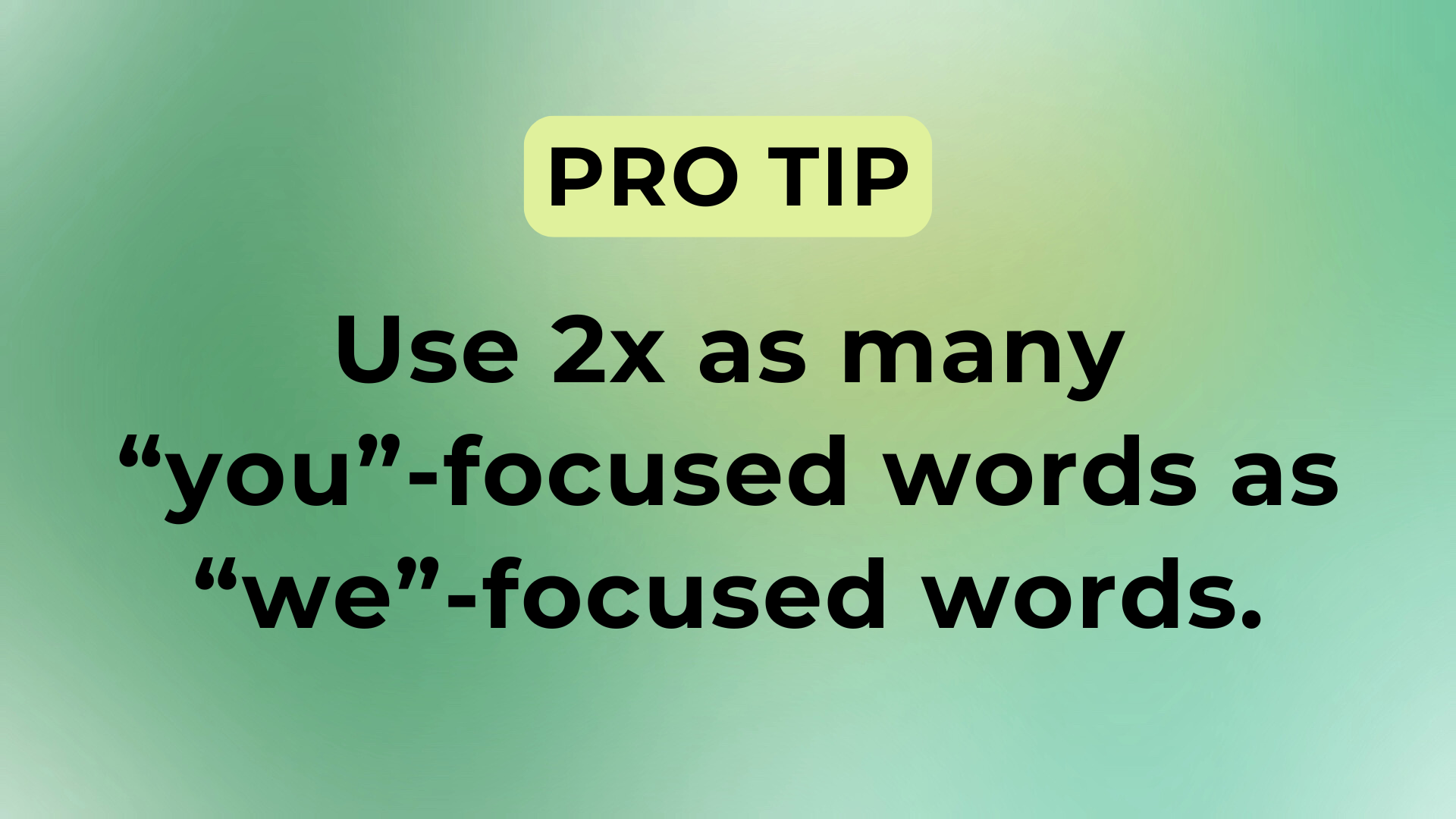
There’s a better word that can be extremely impactful in your communications: “you.” It’s the most powerful word in fundraising and donor stewardship. The golden standard is to use twice as many “you”-focused words as “we”-focused words.
Using “you” in your donor communications turns a monologue into a conversation. It shifts the spotlight from your organization to your reader. It makes them feel exactly what they are: part of the story. Oftentimes, the work your nonprofit does wouldn’t be possible without them.
Compare these sentences:
❌ “We helped 200 kids get school supplies this fall.”
✅ “Because of you, 200 kids walked into school this fall with everything they needed.”
❌ “We served 300 meals.”
✅ “Your donation meant 300 people sat down to enjoy a hot meal tonight.”
Same information, but it leaves your donor with a completely different feeling. The first versions tell the donor what you did. The second versions tell the donor what they did. One feels like a report, while the other feels like a thank-you.
If you read these lines in an email, which would you continue reading? Which would make you want to continue supporting the organization?
Donor Communication Samples: “We” vs “You”
See the difference that framing a sentence from “we” to “you” can make. Read through these examples for different types of communications and notice how the “you” versions feel.
Fundraising Appeals
❌ “We raised $50,000 last year to fund our after-school programs for at-risk children.”
✅ “Because of you, $50,000 went directly to kids who needed a safe place to learn and grow.”
❌ “We need your donation to reach our goal.”
✅ “You can change lives with your gift today.”
Thank You Emails
❌ “We are so grateful for the support we received during our campaign.”
✅ “You showed up when it mattered most. Thanks to you, families in this community will have what they need to thrive.”
❌ “We couldn't have done it without our amazing donors.”
✅ “You made this happen.”
Email Newsletters
❌ “We launched a new mentorship program this fall and we’re currently serving 75 young people.”
✅ “This fall, you helped launch a mentorship program that's already changing the lives of 75 young people.”
❌ “We are excited to share our latest impact report.”
✅ “You'll want to see what your generosity made possible this year.”
Social Media Posts
❌ “We hit our fundraising goal! Thank you to everyone who donated.”
✅ “You did it! Because of your generosity, more dogs will be adopted from the shelter into loving homes. What a win.”
❌ “We are hosting a volunteer event next Saturday.”
✅ “Want to see your impact up close? Join us next Saturday and watch what your support makes possible.”
The “you”-focused sentences are warmer, more personal, and more engaging. Small shifts in framing make a significant difference. The next time you sit down to write an email or social media post, ask yourself: am I talking about us, or am I talking to my donors?
Your donors give because they care about your cause. Your job is to remind them that their care is working, and “you” is the word that does that best.
How to adjust your donor communications right now
Small adjustments to your writing can make a meaningful impact. Start following these steps today:
Step 1. Run your last piece of donor content through an audit tool.
Start with some data and a benchmark to improve upon. Paste your email, blog post, social media post, or direct mail letter into Bloomerang’s free Communications Audit Tool. Analyze your text and find out what your “you” to “we” ratio is.
Step 2. Make small adjustments from “we” to “you.”
Flip the script. Find all the instances of “we” or “our.” Adjust at least half of them to “you” or “yours.” Aim for that 2:1 you: we ratio in all communications with your nonprofit’s donors.
Step 3. Send out your donor communications and see the difference.
Send out your edited communication and notice how your recipients respond. Over time, you’ll likely start to receive more responses. You’ll be on your way to having more engaged supporters that support you in the long run.
If you’re sending an email, you can run it as an A/B test to compare the response.
Want more writing tips to take your skills to the next level? Check out our blog post on 10 copywriting tips to transform your content.
The bottom line: Nonprofit communications are not about you!
Remember, it’s not about you. It’s about your reader. They are the one who made the choice to give, to follow you on social media, to read your blog post, to open your email, or to volunteer with your nonprofit. They didn’t have to. They could have spent their time, energy, and resources in a hundred other ways. But they decided to be part of your work, and that choice matters.
When you write to them, it’s your job to help them feel that impact. Allow them to see themselves in your work and mission. Make them feel glad to be part of what you are building, and let them know you’re grateful they’re here. Your writing can make this crystal clear.
“You helped make this possible.” “Your gift today will…” “You’re the reason we can keep going.”
Every time you use the word “you,” you are humbly handing the credit to the people who help make your work possible. You’ll make them feel like they’re one of the most important people in the room.

Let us know how it goes
We’d love to hear the results of putting this strategy into action for your nonprofit. Get in touch to tell us about your nonprofit, and about your experience using “you”-focused language.
Want help putting this tip into action? Sit back and relax… we’ll put it into practice for you. Learn more about the Purpose Collective’s content creation services.
